Archive for the ‘Archive’ Category

Peace Lutheran offers electronic giving for members and friends who wish to have contributions transferred electronically to the church’s account. Electronic giving gives you a convenient way to keep up with your intended offerings and makes a huge difference in our congregation’s cash flow.  Occasional and one-time contributions are also options.

There are two primary ways to set up your electronic donation.

(1) You may obtain an authorization form from the Peace office or from Peace Financial Secretary David Kehle. (Call the church for info on how to contact David: 206-935-1962)

(2) You may set up your giving directly via our website, following these steps:

  • Click on the RED “MAKE A DONATION” BUTTON at the upper right corner of this page, and follow the prompts.
  • Gifts may be made on a recurring or one-time basis
  • Both debit cards and credit cards may be used. (Think airline miles!  😀 )


You are not alone…no one is alone.”

Into the Woods, Stephen Sondheim & James Lapine

Beloved of God,

None in our family had ever seen the musical Into the Woods,* so when I learned last spring that 12th Night Productions had chosen it for their summer theatre offering I was intrigued. My interest steadily grew as I sat through a number of church meetings at Peace while rehearsals took place downstairs. The voices from below were engaging; the energy of the players high. When we returned from vacation a single performance remained—the Sunday matinee—and Chris acquired the tickets. Now I’ve tried Sunday theater matinees before and they usually don’t work for me. On Sunday afternoons a nap is a more appealing activity than a performance. But we’d really been looking forward to this show, and so Sunday afternoon the four of us piled into the car and went.

What we experienced there in the West Seattle High Theater was absolutely transporting. From the first line of the opening song we were hooked. Hooked not only by the incredible voices from the large and uniformly talented cast, but by the level of artistry they achieved together, and most of all by the message at the heart of the show. There would be no napping through this production!

On the surface, the show is a clever and entertaining interweaving of well-known fairy tales—Cinderella, Little Red Riding Hood, Jack and the Beanstalk, Rapunzel, and others. With music and verse, Sondheim and Lapine masterfully link the stories and their characters to the fundamental human experience of running up against limits, making choices whose consequences linger, and confronting loss while longing for redemption and fulfillment—the “happily ever after” that beckons to us from the other side of the woods. But we have to go “into the woods” in order to get there, and therein lies the tale. Act 1 ends with a note of joyous relief that wishes have been granted, goals have been attained and predicaments solved. Then comes Act 2, and complications ensue. What seemed black and white turns gray.

In her Director’s Note for the show, Mary Opland Springer writes:

In Act 2 we take this journey with [the characters] and realize that a journey into the woods brings as many questions as it answers. In one of the most poignant moments, Cinderella and the Baker share the wisdom they have realized as they sing No One Is Alone

Sometimes people leave you halfway through the wood.

Others may deceive you. You decide what’s good.

You decide alone. But no one is alone.

Mary goes on:

Sondheim so aptly said, “No One is Alone…is what the show has been about. No one is alone: we are all connected in some way and we are all responsible for each other’s actions.”

The Rev. Martin Luther King, Jr. once said something similar in a letter he wrote from a Birmingham jail cell:  “We are caught in an inescapable network of mutuality, tied in a single garment of destiny. Whatever affects one directly, affects all indirectly.”[1]

Our family of four—kids as well as adults—were entranced by the artistry of the cast and musicians in their portrayal of this masterful show. Kai and Naomi quickly pronounced it “the best play ever,” and Chris and I found ourselves profoundly moved as we recognized in the drama on stage some of our own experiences of being stuck “in the woods.” The show reminded us that this is what the journey we’re on together—all of us—is about: we are not alone. We experienced this as gospel. We have one another. And more than that, we are companioned by One who enters “the woods” by our side; who will do whatever it takes to get us through to the other side.

As the season turns and the launch of a new school year begins, we need this reminder. And the good news is, we get to hear, touch, and taste it each Sunday we come together. We need each other. We are not alone.

See you at the Table,

Pastor Erik

___________________________

* Music by Stephen Sondheim, libretto by James Lapine

[1] Find the full text of King’s letter here: http://www.africa.upenn.edu/Articles_Gen/Letter_Birmingham.html

Our worship service at Peace now begins at 10:3oam.

Memorial Service will be held at Peace Lutheran on Saturday, August 22 at 1PM.

“The LORD told Abram ‘GO’… And Abram went.”

– Genesis 12

Beloved of God,

Summertime has always been, for me, a time when I look forward to traveling; a time for entering new spaces and rhythms in family and congregational life; a time for visiting new and familiar landscapes and coming home renewed.   Last year at this time our family was re-entering life in the Northwest after having been on sabbatical.  We’ve been playing the “where were we a year ago?” game for the past four months, and it’s enabled us to recapture some of the experiences we shared along the way and to keep alive the prospect of returning “someday” to places and people we came to cherish along the way.

When God issues the call to Abram to leave everything he’s known—country, hometown, family—and to go to a new place that God will show him, God promises Abram that through him “all the families of the earth will be blessed.” (Gen. 12:3)  In response to this call, “Abram went.”  Historian Thomas Cahill calls these two words “two of the boldest words in all literature” for they signal a complete departure form everything that has gone before in the long evolution of culture and sensibility.  “Out of ancient humanity,” writes Cahill “comes a party traveling by no known compass.  Out of the human race…comes a leader who says he has been given an impossible promise. Out of mortal imagination comes a dream of something new, something better, something yet to happen, something—in the future.”[1]  What’s being midwifed in this encounter, according to Cahill, as a whole new concept—the concept that what lies ahead us could be different from what we’ve known before; the concept of FUTURE.

These days we take the FUTURE for granted. That is, we take the idea that tomorrow could be different than today —and different in significant ways and better ways—for granted.  The recent Great Recession, the acceleration of Climate change, and the continuing specter of terrorism may have put a chink in that armor, but by and large we (at least I) carry in my head the notion that the future is not predetermined or just a rerun of the past, but can be different; that I can change, that circumstances can improve, that the world can be better. 

Theologically speaking, Lutherans have held a dim view of the human capacity to change.  The mystery of the cross lies at the very heart of our way of seeing God at work in the world, suffering and dying and coming face to face with all that is wrong with human existence.  “We are in bondage to sin and cannot free ourselves,” we confess!  Yet Christ’s crucifixion is not the final act or word.  God’s final word is RESURRECTION, and it is not only a word, it is an ACT as well as a PROMISE.  What drives my conviction that my future and the world’s future can be different is my faith in the resurrection of Jesus.  On Easter morning we learn that God has something more planned for us and this world than a trajectory that ends in the graveyard.  We have a future “hidden in God,” a “better country” to look forward to; one that begins now and will reach its full embodiment when God deems it time.  Our job is to trust that truth and to live into it.  This resurrection faith gets affirmed in profound ways when I have the privilege of accompanying people of faith as they prepare to cross from this life to the next.

As I write to you, the recent death of our brother in Christ Al Drackert on June 29th is fresh in my mind.  When I last saw Al at his apartment at Daystar the day before he died, he was lying in his bed.  As I leaned over him he looked up at me, opened his eyes, smiled his crooked smile, and said, “Thanks for everything, Pastor.”  Oh, thank YOU, Al.  Later, when Chris arrived with her flute, we sang some of his favorite hymns with the members of his family who were present, and Al hummed along, chiming in “that’s a good one.”  At the edge of death Al was praising and thanking God.

Al knew the meaning of gratitude and found a way to express it on a daily basis.  One of his favorite phrases was “gracious living.”  Whether he was with his friend Bob Gains delivering Meals on Wheels, or passing the peace in worship, or reflecting on life from a hospital bed, he always steered back to that place.  His inner compass was locked on Grace, and because of that his eyes were opened to see blessings blossom all around.  “I am amazed” he would say.   As he prepared to make his final journey from this life to the next, Al seemed fully prepared to relinquish what he’d known here and to place his life with trust in the arms of the God of resurrection, the God who holds the future.  Blessed to be a blessing.

We are all blessed to be a blessing.  God’s promise to Abram is still being worked out in the lives of people of faith across the globe, in your life and mine, as we journey through this life.  Wherever our journeys take us this summer, whether near or far, we all will be given myriad opportunities to bless those we encounter; to pass God’s grace and blessing on. 

Via con Dios – Go with God!

Pastor Erik


[1] Thomas Cahill.  The Gifts of the Jews.  (New York: Anchor Books, 1998) p. 63

OPEN TO PUBLIC
Walk in Friday, December 30, 2016 Seattle Peace Lutheran Church 1:00 PM- 7:00 PM
closed for lunch from 3:00 PM 4:00 PM

“When you send forth your Spirit, we are renewed, we are renewed!” – Psalm 104

Beloved of God,

If you were in worship on Pentecost Sunday (May 24), you participated in a conversation break during the sermon.  The theme for Pentecost Sunday was the Spirit being unleashed on Christ’s disciple community—PUSHING THEM OUT into the public square to engage with others and share the good news of what God was bringing to the world through Jesus.  The first question folks were invited to discuss in small clusters around the sanctuary was: 

What is the chief resource of our congregation?

Your most common response was “the people.”  Many cards had modifiers attached, like “caring people” or “motivated people” or “welcoming people” or “young people.”  Other answers clustered around our building as a resource and how it is used or could be used to help the neighbor.  Still others identified the “welcoming spirit” and “friendliness.”  These answers are not surprising.  The congregational culture of Peace, its “DNA” so to speak, expresses itself in warm and welcoming hospitality.

But it’s not enough to identify what the chief resource of our congregation is; we have to make certain we utilize that resource to connect our congregation to the neighbors and neighborhoods that surround us.  To that end, folks were asked to discuss a second question:

How can we use that resource to connect to the neighbors that surround us?

To this question there were a great variety of responses.  Some of them focused on getting us OUT of the building and interacting with neighbors, or hosting events outside that supported interaction with neighbors.  Some mentioned what we’re already doing and others suggested more fully utilizing music and the arts as a means to interaction.  I hope that conversations around these questions will be ongoing ones for us.  If you have any brainstorms, please jot them down and share them with me or with Bob Wightman, our president—we’d like to hear from you!

The fact is, we are doing much to convey the message that we are a congregation that cares about its neighbors.  Whether it’s hosting Mary’s Place families, supporting local food banks, building Little Libraries, sharing our facility, building raingardens, floating seal rafts, doing biannual landscape projects in the community, serving meals at Compass Center, or going about God’s work with our hands in other ways, I believe we sense the importance of bringing our vision and our energies to birth out in the world.  Surely this is the Spirit’s call!  I believe that this, in part, is why our congregation is bucking the trend of most urban congregations and GROWING in membership rather than SHRINKING.  

The pulsing core of our mission begins in our gatherings around God’s Word, Font and Table.  Without the experience of weekly worship, our batteries run down and our motivation for service suffers.  But our worship life is only the beginning.  Our life of faith never stops here or ends here or stays here.  The Spirit propels us ever outward, just as it propelled the disciple community out of their homes and into the streets.  Wherever the Spirit propels you these coming months, I pray that it will be an enriching and rejuvenating time, and a time when you are able practice your vocation as a bearer of good news in ways that make a difference!

Yours in Christ,

Pastor Erik


“We love because he first loved us.  Those who say, “I love God,’ and hate their brothers or sisters, are liars;
for those who do not love a brother or sister whom they have seen, cannot love God whom they have not seen.”
1 John 4:19-20

Beloved of God,

I can’t say when I first heard of Pastor André Trocmé or the protestant village of Le Chambon-sur-Lignon, but I’ve always been drawn to people of high moral integrity.  So when I heard the story of a village in France that harbored Jewish refugees during WW2 at great risk, I was captivated by it.  When I began planning my sabbatical, Le Chambon emerged as one place I wanted to see firsthand.  I wanted my family to get as close as possible to this story and the people and principles behind it.

At first, I had limited luck in my internet searches for information about whether a museum dedicated to the heroic efforts of the people there existed.  I could only find references to a temporary museum that once existed, or to the dream that a museum might one day be built.  But then I found an article by Dr. Patrick Henry, a retired professor from Whitman College.  His article gave a brief but thorough explanation of the historical context in which this “conspiracy of goodness” took place.  As time before our departure for sabbatical was running short, I tracked down his email address and wrote him, hoping he might respond.   Not only did he write back almost immediately, sharing information that proved immensely helpful as I prepared for our visit to Le Chambon, unbeknownst to me he blind copied Nelle Trocmé Hewitt, the daughter of Pastor André and Magda Trocmé.  Within a few hours of my initial inquiry I found myself corresponding with a woman who not only knew of Le Chambon, she had been at the epicenter of these events as both a witness and participant!  Nelly provided me with information about the newly opened state-of-the-art museum in Le Chambon, Lieu de Mémoire, as well as the names of contacts she knew.  And she urged me to see Pierre Sauvage’s film Weapons of the Spirit, before I left town—which I did.  The entire series of exchanges was a Spirit-inspired gold mine!

On May 3rd you have the opportunity to hear more about this incredible story of neighbor love that took place in Le Chambon and the surrounding farms and villages of the Vivarais Plateau.  Dr. Henry will address the combined Adult and Youth classes from 9:15am to 10:15am.  Then, following worship, we’ll share a simple lunch in the Fellowship Hall, as we view the film Weapons of the Spirit and continue our conversation together.  I hope you’ll come.

“When you send forth your Spirit, we are renewed—we are renewed!” – Psalm 104

Throughout the Easter season we hear stories from the book of Acts which speak to the Spirit-infested power of the gospel life, which spins good news out into the world with untamable, centrifugal force.  Old boundaries fall away in the wake of such a force; and new connections into the community of Jesus abound.  Readings from the letters of John, like the excerpt above, remind us that everything that comes from God is predicated on LOVE. “Those who do not love a brother or sister whom they have seen, cannot love God whom they have not seen,” writes John.  Whatever fears may seek to lay hold of us, skewing or dominating our lives and keeping us curved in on ourselves, says John, as we place our trust in the God revealed to us in Jesus, God’s “perfect love casts out our fear.”  When that happens, the unknown loses its ability to keep us in bondage.  And when this happens, incredible acts follow.

In his memoire, Pastor Trocmé wrote of the important role played by the parish’s Bible study leaders and group meetings: “It was there, and not elsewhere, that answers from God came regarding the complicated problems we had to resolve for the housing and hiding of Jews…It was there that we conceived of non-violent resistance.”1 Through their animated discussion of the Bible and its role in their lives, these groups “saved the situation” in Le Chambon.  They provided opportunities for faithful reflection and the development of strategies for sheltering those fleeing from the German and the French authorities.

The work of the Spirit continues in our own day and context, and our job is to align ourselves—individually and communally—with the Spirit’s mission.   When we keep our hearts, minds, and bodies opened to the Spirit’s breath, we will end up in some surprising places!  That’s the journey we’re on together, as we sing with the Psalmist:

“When you send forth your Spirit, we are renewed—we are renewed!”

With you on the Way,

Pastor Erik

­­­­­­­­­­­­­­­­­­__________________________

1 Alicia J. Batton, University of Sudbury, Ontario. Reading the Bible in Occupied France: Andre Trocmé and Le Chambon. p. 14.  Quoted from A. Trocmé, Autobiographie “André and Magda Trocmé Papers,” copyright Swarthmore College Peace Collection, 1960’s) 357.

Tree of life 2 - Copy

“They put him to death by hanging him on a tree; but God raised him on the third day.”  – Acts 10:39, 40

“The world breaks every one, and afterward, many are strong at the broken places.”

Ernest Hemingway, Farewell to Arms


Dear Easter People!

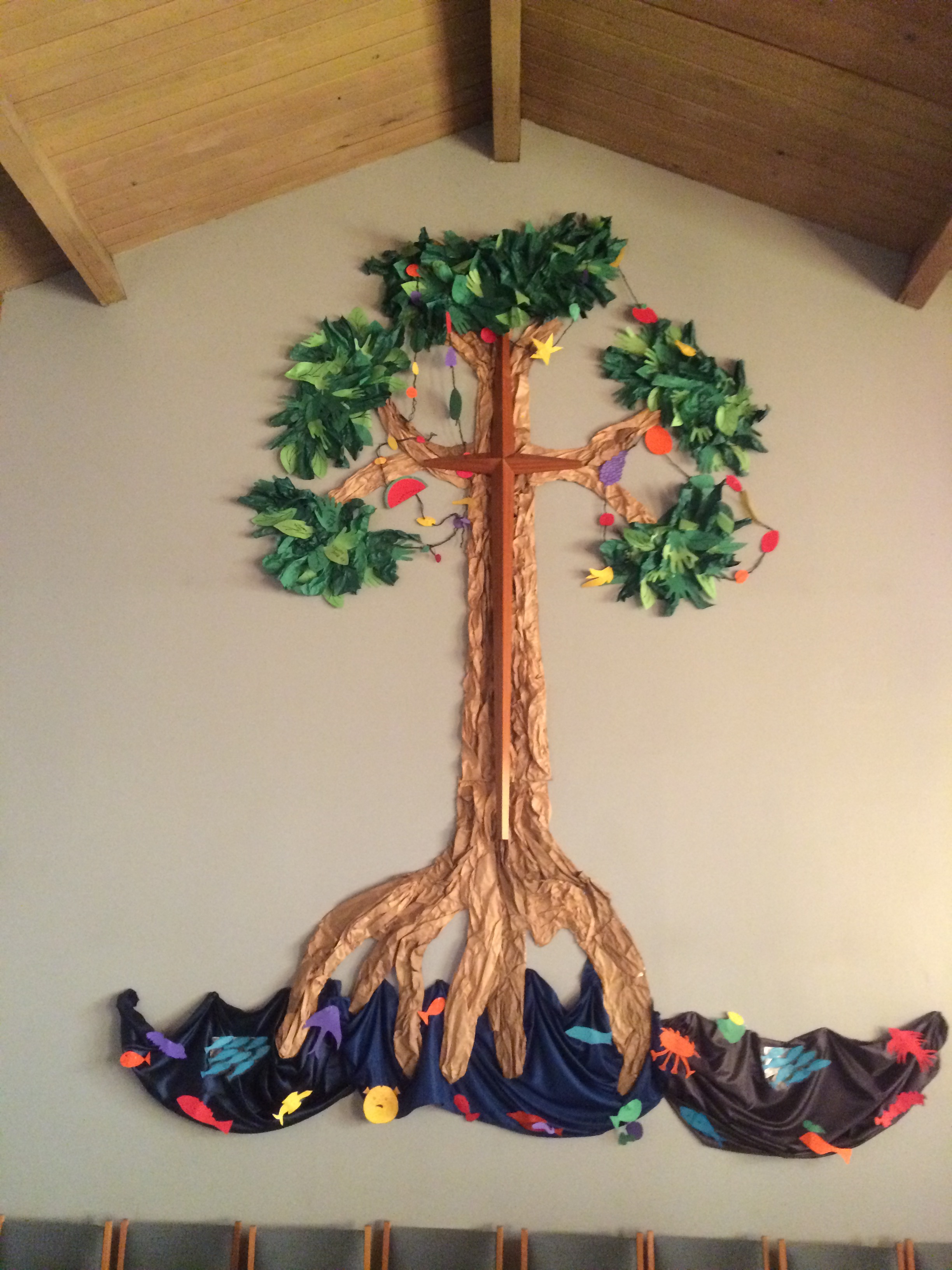
Throughout the Lenten season we have watched as the cross on the east wall of our sanctuary has gradually become the Tree of Life.  God’s act of raising Jesus from the dead transforms what the world forever intends to be the tree of crucifixion into the Tree of Life!  This is the new reality we celebrate on Easter.  The final verdict God pronounces upon us and on all creation is not a sentence of death but rather a sentence of LIFE! 

This doesn’t mean that all the woundings that life inflicts on us magically disappear on Easter—they don’t.  The risen Jesus himself reveals this truth to us.  In his appearance to the disciple community after his resurrection, both in Luke and in John, Jesus shows them his wounds.  His hands, feet, and side still bear the marks of the nails and spear.  And yet, these wounds no longer hold him captive, for they have been healed.  “The world breaks every one,” wrote Hemingway, “and afterward, many are strong at the broken places.”  The resurrection makes all who put their trust in the God of Jesus strong in the broken places.

Recently a colleague introduced me to a centuries-old Japanese art for fixing broken pottery. It’s called kintsugi or “golden joinery”.[1] Instead of discarding broken bowls, plates and vases, this approach to pottery (and to life) celebrates the artifact’s unique history by emphasizing the fractures and breaks instead of hiding or disguising them.  The pottery is bound in its broken places with a special lacquer and then dusted with powdered gold, silver, or platinum.  The result: beautiful seams of gold glint in the cracks of ceramic ware, giving it a truly unique appearance.  It is often the case that this approach to repair makes the repaired piece even more beautiful than the original, revitalizing it with new life.  The art of kintsugi, which dates back more than 500 years, is related to the Japanese philosophy of wabi-sabi: finding beauty in the flawed or imperfect.

Franciscan Richard Rohrer calls imperfection “the organizing principle of the entire human spiritual enterprise.”  St. Francis, says Rohrer, wore patches on the outside of his habit so everyone would know what he was like on the inside.  “Imperfection,” says Rohrer, “is not to be tolerated, marginalized, excused, or contextualized, or even forgiven, it is the framework in which God makes the Godself known and calls us into union.”

As we celebrate the resurrection of Christ, and God’s promise that we, too, will be raised with Christ to new life, we rejoice!  For we now know that the Master Potter who formed us in the beginning will re-form us in all our broken places, repairing the fragile vessels of our lives so that they stand—even now—as emblems of beauty and grace: the broken made whole. 

Alleluia! 

Pastor Erik