

Archive for the ‘Pastor’s Pen’ Category

“The import of the commandment against killing is this: In the first place, we should not harm anyone… In the second place, this commandment is violated not only when a person actually does evil, but also when he fails to do good to his neighbor, or, though he has the opportunity, fails to prevent, protect and save him from suffering bodily harm or injury.”

– Martin Luther, The Large Catechism

Beloved of God,

The church building is a quiet place these days.  Too quiet.  As I’ve ridden my bicycle to Peace in recent weeks, there have been days when not a single car has crossed my path.  Much of any given day I’m the only body here at Peace.  Yes, the building is abnormally quiet—and yet my days are full of people: phone calls, ZOOM meetings, collaborations with Peace staff and leader, conversations with pastoral colleagues, virtual huddles with our Tech Team to produce videos and plan ways for maintaining connection with each other during this time of forced separation.

The shift to this new world happened so swiftly that many of us found ourselves reeling; yet many of us are finding ways to acclimate ourselves to this new normal, which we now know will be in place at least through May 4th.  In the process of acclimation, some of us are discovering capacities we didn’t know we had.  A recent phone call to the Sunde household revealed that, with a little ingenuity and a few strategic purchases, face shields were being made for a local medical team.  Another phone exchange revealed how Michael T. was becoming the “go-to” coffee and chocolate supplier to his neighborhood using Fair Trade items that would otherwise sit untouched in the Peace narthex.  Working from their home studio, Jon and James have recorded music to embroider my weekly audio and video messages; and Laura B. has been writing original music to accompany the Holy Week reflections written by Boots W—and on it goes. The upshot?  This novel virus is unleashing novel ways of serving others—God’s Spirit is alive and well among us and for that we can give thanks!

If your household has discovered new ways of connecting with and serving others, I’d love to hear about it!  Please share it with me via phone or email.

Brother Martin, in excavating the deeper layers of the 5th Commandment, reveals that at its core the prohibition to murder is more than a line in the sand God commands us not to cross—it is an invitation to proactively look out for the welfare of our neighbor.  This kind of proactive commitment to care for those around us is in high demand these days.  As much as our focus of care surely should be on those within our family and household circle, can we also extend our field of vision to include neighbors who may have needs we can help address?  I know that many of you are doing just that—and doing so while maintaining proper safety protocols!  You, my friends, are doing God’s work!  While the 24/7 flood of dire news about this pandemic can have a debilitating effect on us, making us cautious about every interaction, and causing us to turn in on ourselves, it need not be so among us.  Through the centuries people of faith have demonstrated in a variety of ways both great and small what neighbor-love can look like.  We continue in that long stream.

Pastor Erik
Dear Friend,

During this time when we are learning to cope the best we can with these circumstances forced upon us because of COVID-19, creativity is being unleashed in the world in powerful ways which inspire hope.   A beautiful example of this creativity came to my email inbox from my sister in Massachusetts: a virtual recording of Beautiful City (from Godspell) put together by the Southshore Children’s Choir.  Hearing these young voices brought tears to my eyes!

Another beautiful example is the poem by Capuchin Franciscan Brother Richard Hendrick of Ireland, which has been making its rounds.  You can find his original post here:

Lockdown

by Capuchin Franciscan Brother Richard Hendrick

Yes there is fear.

Yes there is isolation.

Yes there is panic buying.

Yes there is sickness.

Yes there is even death.

But,

They say that in Wuhan after so many years of noise

You can hear the birds again.

They say that after just a few weeks of quiet

The sky is no longer thick with fumes

But blue and grey and clear.

They say that in the streets of Assisi

People are singing to each other

across the empty squares,

keeping their windows open

so that those who are alone

may hear the sounds of family around them.

They say that a hotel in the West of Ireland

Is offering free meals and delivery to the housebound.

Today a young woman I know

is busy spreading fliers with her number

through the neighbourhood

So that the elders may have someone to call on.

Today Churches, Synagogues, Mosques and Temples

are preparing to welcome

and shelter the homeless, the sick, the weary

All over the world people are slowing down and reflecting

All over the world people are looking at their neighbours in a new way

All over the world people are waking up to a new reality

To how big we really are.

To how little control we really have.

To what really matters.

To Love.

So we pray and we remember that

Yes there is fear.

But there does not have to be hate.

Yes there is isolation.

But there does not have to be loneliness.

Yes there is panic buying.

But there does not have to be meanness.

Yes there is sickness.

But there does not have to be disease of the soul

Yes there is even death.

But there can always be a rebirth of love.

Wake to the choices you make as to how to live now.

Today, breathe.

Listen, behind the factory noises of your panic

The birds are singing again

The sky is clearing,

Spring is coming,

And we are always encompassed by Love.

Open the windows of your soul

And though you may not be able

to touch across the empty square,

Sing


Christ walks with you

Keep calm.  Stay safe.  Carry on.

P Erik

Grace, mercy and peace to you on this 5th Sunday in Lent.

My message this week is being made available to you both as a VOICE RECORDING as in past weeks, AND as a VIDEO RECORDING. The message is tied to two Scripture readings for this Sunday: Ezekiel 37 and the 11th chapter of John, both of which speak powerfully to the experiences we’re going through right now—one takes us to the VALLEY OF DRY BONES; the other to the TOMB OF LAZARUS.

Once again, I’m grateful for our TECH TEAM and MUSICIANS which made these recordings possible.

God keep you close as you listen in!

Pastor Erik

Lent 5A recorded message for 3-29-2020Audio

Lent 5A PRELUDEWhat Wonderous Love is This Piano Solo James Jelasic

Lent 5A POSTLUDERestore in Us, O God – Jon and James

O Love of God How Strong and True – Jon and James(1)

Here’s an uptempo version of I WANT JESUS TO WALK WITH ME (YouTube) by Laura Bermes: https://youtu.be/iCjcA6n9gv4


Lent 4A recorded message WAV for 3-22-2020

Dear Friends,

I hope that as you listen to today’s message you and those you love are managing well as we continue our journey through this unprecedented time.  As social isolation becomes more strict, adjustments must be made that test our capacity for change.  Yet, in times such as these, we may find ourselves summoning capacities we didn’t know we had! I hope you feel new capabilities rising within you and members of your circle, so that the changes being asked of you are not overwhelming.

I’ll continue sending weekly communications via email as well as posting on the SPECIAL ANNOUNCEMENTS section our homepage: www.peacelutheranseattle.org.

I’m working closely with our technology team to enlarge our capacity to connect with each other during this time.  We hope to expand options for group and individual video sharing soon.  I’m grateful to Jon and James for the music offerings contributed today, and to Dustin Smith for knitting it all together.

To listen to the music that accompanies this message, click below.

PRELUDESavior, Like a Shepherd Lead Us and JSBachJamesSolo

POSTLUDEJesJoyHighKingofHeavenJamesSolo

INSPIRATIONALSONGIHeardtheVoiceofJesusSayJonandJames

Peace member and performer Laura Bermes created this rendition of Amazing Grace for us that also fits into the day’s theme about moving from blindness to sight.  You can find her performance here on YouTube: https://youtu.be/TdPMM5iS05k

The peace of the Lord be with you always.

Pastor Erik

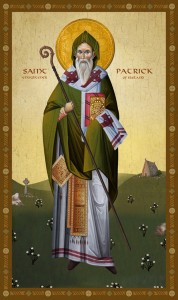
Lent A recorded message St. Patrick 3-17-2020 (2)

St. Patrick, Patron Saint of Ireland, (c. 389-March 17, 461)

St. Patrick

Patrick grew up in a somewhat privileged family, on the west coast of Britain during the waning days of the Roman empire.  And though his father was a Christian deacon and his grandfather a priest, Patrick, as a child, was not very religious.  But when he was kidnapped as a teenager by Irish raiders, his life was turned upside down.

Sold to an Irish chieftain, Patrick found himself in exile—herding sheep and living in isolation and deprivation in the north of Ireland.  It was there, during six long years of captivity, that he discovered the voice of God speaking to him from within.  Responding to that voice, he fell into a rhythm of prayer each day.  It was this same voice that inspired Patrick, six years later, to make his risky escape from slavery.

Walking 200 miles through forests and bogs, he found his way to a port and onto a ship, and, eventually, was reunited with his family.  This experience of exile seeded a spiritual conversion within Patrick and he started on a new path of love for God, for his neighbor, and even for his enemies.

Much to the consternation of his family and the amazement of his former owners, he returned to Ireland years later as a missionary to preach and practice the love and mercy of God.

The hymn of St. Patrick is often referred to as a lorica or breastplate prayer.  “Lorica” means a protective sheath, and loricas were to be chanted while dressing, arming oneself for battle, before travel, and as a protection against spiritual enemies.  This prayer expresses Patrick’s faith and zeal in a powerful and memorable way as he invokes the power of the Holy Trinity, the powers of heaven and earth, and Christ himself, to accompany him in all circumstances and guard him from the powers of evil.

In recent years Patrick’s prayer has become precious to me.  Reciting it daily helps to keep me grounded as I attend the challenges each day brings.  As restrictions aimed at limiting the spread of COVID-19 broaden and personal concerns for protection deepen, spiritual resources that ground us become more and more important.  Reciting St. Patrick’s Breastplate Prayer doesn’t magically protect us, but it can help us plant ourselves on faith’s firm footing as each day begins.  I share it this with you now with the invitation that you seek out, in your own way, spiritual resources that will serve to ground you in these times.[1]

ST. PATRICK’S BREASTPLATE

I bind unto myself today the strong name of the Trinity

by invocation of the same, the Three in One and One in Three.

I bind this day to me for ever, by pow’r of faith, Christ’s incarnation,

his baptism in the Jordan River, his cross of death for my salvation,

his bursting from the spiced tomb, his riding up the heav’nly way,

his coming at the day of doom, I bind unto myself today.

I bind unto myself today the virtues of the starlit heaven,

the glorious sun’s life-giving ray, the whiteness of the moon at even,

the flashing of the lightning free, the whirling wind’s tempestuous shocks,

the stable earth, the deep salt sea, around the old eternal rocks.

Christ be with me, Christ within me,

Christ behind me, Christ before me,

Christ beside me, Christ to win me,

Christ to comfort and restore me,

Christ beneath me, Christ above me,

Christ in quiet, Christ in danger,

Christ in hearts of all that love me,

Christ in mouth of friend and stranger.

I bind unto myself the name, the strong name of the Trinity

by invocation of the same, the Three in One and One in Three,

of whom all nature has creation, eternal Father, Spirit, Word.

Praise to the Lord of my salvation: salvation is of Christ the Lord!

[1] By the year 690 his hymn was being sung in churches and monasteries throughout Ireland and has been ever since.  When Cecil Francis Alexander was asked to make a metrical version of the hymn, she wrote a paraphrase based on a 12 century manuscript which was sung for the first time on St. Patrick’s Day in 1889.  This hymn form made its way into our Evangelical Lutheran Worship hymnal #450.  For another version of the Breastplate, sung to The Deer’s Cry, listen to this lovely lyrical version sung by Irishwoman Rita Connolly: https://www.youtube.com/watch?v=xeVEGOPjJXQ


Recorded message for 3-8-2020

March 8, 2020

Sisters and Brothers,

Pastor Erik here, sending grace, mercy, and peace to you from God our Creator, from Jesus the Christ, and from the Holy Spirit, who holds us in community even when we’re unable to be physically together in one place.

We are living through an extraordinary time right now, as our region and the world grapple with the spreading coronavirus—COVID-19.  It’s a time of high anxiety with many unknowns.  In conformity with recommendations made by the Health Department, we have cancelled our education classes and worship service for today, March 8th, as well as our Wednesday evening meal and prayer service on March 11th.

Since we cannot be together this morning in worship, I wanted to share some encouragement with you today by reflecting on this moment through the lens that the Scriptures and our faith provide.  And so, attached to this post you’ll find a message I recorded this morning.  I invite you to open the recording some time today, and listen to what I want to share with you.

I will be at the church from 9:30am to Noon today, Sunday March 8, in the event you’d like to talk or pray.

Peace be with you.

Pastor Erik


“One of the most obvious characteristics of our daily lives is that we are busy. We experience our days as filled with things to do, people to meet, projects to finish, [emails] to write, calls to make, and appointments to keep.  Our lives often seem like overpacked suitcases bursting at the seams.”

– Henri Nouwen, Making All Things New

Dearly Beloved,

Do Nouwen’s words reflect your reality the way they do mine?  I love (or is it loathe?) the image of an overpacked suitcase bursting at the seams.  With all the transitions going on in our family life of late, “down time” seems more elusive than ever—and I know I’m not alone.  The season of Lent brings additional layers of activity and possibilities for the life we share in community, but I hope and pray the effect is not to make those suitcases burst even more!  In truth the opposite is what Lent strives for:  to help us unpack the suitcase and stay awhile.

Nouwen continues his thoughts:

“From all that I said about our worried, over-filled lives, it is clear that we are usually surrounded by so much inner and outer noise that it is hard to truly hear our God when he is speaking to us. We have often become deaf, unable to know when God calls us and unable to understand in which direction he calls us.  Thus our lives have become absurd.  In the word absurd we find the Latin word surdus, which means “deaf.” …when we learn to listen, our lives become obedient lives.  The word obedient comes from the Latin word audire, which means “listening.” A spiritual discipline is necessary in order to move slowly from an absurd to an obedient life, from a life filled with noisy worries to a life in which there is some free inner space where we can listen to our God and follow his guidance.”

Freeing inner space in order to tune in to God; coming back to ground—that’s the essence of Lent. To get there we may need to take stock of our overscheduled lives, prune back obligations, and slow the rhythm of our days enough that we can move from absurd deafness to obedient listening. This kind of listening doesn’t magically happen all at once.  It’s a practice that must be cultivated; and cultivating anything takes time.

Jesus, says Nouwen, was “all ear.”  Always listening to the Father, always attentive to his voice, always alert for God’s directions. It was this being “tuned in” to God that enabled Jesus to tell his followers:

“Do not worry about your life…do not worry, saying, ‘What will we eat?’ or ‘What will we drink?’ or ‘What will we wear?’ For … your heavenly Father knows that you need all these things. But strive first for the kingdom of God and his righteousness, and all these things will be given to you as well.” (Matthew 6)

The Lenten disciplines of prayer, fasting, and almsgiving are not ends in themselves but are tools which, by holding our attention, help us detach from lesser obligations, freeing up bandwidth for us to pay better attention to our spiritual lives. Claimed by God in baptismal waters we are beloved children!  The daily agenda for our lives has its starting point here.

With anxiety on the rise due to spreading corona virus, volatile financial markets, and the uncertainties of this election year, we do well to exercise care in choosing which voice(s) we will tune our ears to hear.  As we gather at the Table and tune in to the words “this is my body…this is my blood…given for you,” we are assured that Christ will walk with us through thick and thin, up and down, beckoning us to unpack our overstuffed suitcases and exchange our absurd lives for obedient ones.

With you on the Way,

Pastor Erik


“You are the light of the world. A city on a hill cannot be hid. No one after lighting a lamp puts it under the bushel basket, but on the lampstand, and it gives light to all in the house.  In the same way, let your light shine before others, so that they may see your good works and give glory to your Father in heaven.”

– Jesus, Matthew 5:14-16

Beloved of God,

Ironic, isn’t it, that the so-called Season of Light we mark this time of year comes at a most dark and dreary time. The thick cloud cover we’ve been experiencing, coupled with the relentless rain, [SIDEBAR: Yes, I am grateful for all the mountain snow…] can give the impression that we’re actually getting less sunlight now than we did during December’s winter solstice.  Cue Jesus, who has the audacity this month to call us “the light of the world.” I don’t know about you, but sometimes it can be hard to shine—even when we know that’s our job.

In a story he tells about candles in a closet, Max Lucado, I think, gets it right. As the story begins an electrical storm has caused a blackout in his home, so Max feels his way to the closet where the candles are kept. Lighting a match, he finds the shelf of candles.  But as he turns to leave with the largest one lit and in hand, a voice tells him to STOP WHERE HE IS, and he finds himself in conversation with the candle.

“Who are you? What are you?”

        I’M A CANDLE… Don’t take me out of here!

“What?”

        I said, don’t take me out of this room.

“What do you mean? I have to take you out. You’re a candle. Your job is to give light. It’s dark out there.

People are stubbing their toes and walking into walls. You have to come out and light up the place!”

        But you can’t take me out. I’m not ready, the candle explained. I need more preparation.

I couldn’t believe my ears. “More preparation?”

Yeah, I’ve decided I need to research this job of light-giving so I won’t go out and make a bunch of mistakes. You’d be surprised how distorted the glow of an untrained candle can be. So I’m doing some studying. I just finished a book on wind resistance.  I’m in the middle of a great series of tapes on wick build-up and conservation – I’m reading the new best seller on flame display.  Have you heard of it?”

“No,” I answered.

You might like it. It’s called Waxing Eloquently.

Having given up on that particular candle, Max chooses a different one, but the same problem follows. Each candle offers a different excuse for why it can’t go public with its light. None is ready to leave the relative safety of their place on the shelf.  Max pleads with them, but to no avail. Finally, the story ends this way:

I put the big candle on the shelf and took a step back and considered the absurdity of it all. Four perfectly healthy candles [willing to talk about light] but refusing to come out [and let it shine.] I had all I could take. One by one I blew them out…I stuck my hands in my pockets and walked back out into the darkness.

“Max,” asked my wife, “Where are the candles?”

“They don’t…they won’t work. Where did you buy those candles anyway?”

“Oh, they’re church candles. Remember the church that’s closing? I bought them there.”

“At last,” says Max, “I understood.” [1]

Of course the story of is more complicated than that, as all who have struggled to keep a congregation alive well know. Many factors contribute to the rise and fall of a congregation’s life cycle.  Right now, Peace happens to be in the midst of a growing phase, with young and growing families.  What a joy it is!  We’re beating the trends of many of our sister churches.  But those trends can shift if we find ourselves only paying attention to what happens between our walls.

Jesus says so clearly: YOU ALL ARE THE LIGHT OF THE WORLD.  Not, YOU HAVE POTENTIAL TO BE LIGHT, but YOU ARE THE LIGHT OF THE WORLD.  We are called as a congregation to visibility!  Sometimes the walls of a church building can become barriers to that visibility.  Sometimes it feels safer inside, with people I know—or am getting to know—and it feels risky to go out purposefully, as community, into the neighborhood, and say WE STAND FOR LIGHT – WE WILL BE LIGHT.  But in order for light to be seen it must come out of the closet.

What does LETTING LIGHT SHINE mean for us as this second decade of the 21st century unfolds?  It’s a question and a challenge we are called to keep ever before us. We say it this way in our vision statement:

“…We are called to discern God’s presence and invitation into unfamiliar places, and to venture beyond ourselves, so all people will experience God’s love.”

“Beyond ourselves…” In other words, we are called to visibility. Called to venture out of the closet. To bring light; to be light.  And to borrow and share light, especially at times when it seems that the world’s light stores are running low.  That’s a message I, for one, need to hear in the midst of gloomy, dreary days.

Thank you for sharing your light with me.

Pastor Erik

[1] Max Lucado, God Came Near – Chronicles Of The Christ. (Nashville: Thomas Nelson, 1986, 2004). Some edits for brevity.

“Come bow beneath the flowing wave. Christ stands here by your side

and raises you as from the grave God raised the crucified.”

– Thomas Troeger

Beloved of God,

When the crab boat Scandies Rose went down in frigid Alaskan waters last week, rescuers managed to save two of the seven crew members, plucking them from a life raft in the middle of the night in high seas and a -10 wind chill.  As hard as it is for me to imagine crewing on a crab boat it’s even harder for me to imagine being on a Coast Guard rescue crew that would be called to action under conditions such as these.  (The year I tried out for the high school water polo team quickly led me to the conclusion that water was not my medium for athletic success!)  The truth is the Coast Guard’s rescue diver training program is the toughest and most demanding of any branch of the military.  The attrition rate for the training program hovers around 50%.  The base physical fitness requirements are daunting—performance minimums include:  50 push-ups, 60 sit-ups, 5 pull-ups, 5 chin-ups, a 500 yard crawl swim in 12 minutes, a 25 year underwater swim (repeated four times), a buddy tow of 200 yards. Recommended fitness metrics are even higher.  Add to these the need to think clearly and perform challenging tasks while submerged, holding your breath, and getting tossed around my 10-20 ft. waves; then mix in the harsh and frigid conditions that are the norm for boats plying Alaskan waters in the winter, and my awe and admiration for those who feel called to this work grows ever higher.  A high level of discipline is required of those who take on these physically and psychologically demanding roles.

In her book on the Rule of Benedict, Joan Chittister writes about another kind of discipline; the discipline of the spiritual life:

“The spiritual life is not something that is gotten for the wishing or assumed by affectation. The spiritual life takes discipline.  It is something to be learned, to be internalized.  It’s not a set of daily exercises; it’s a way of life, an attitude of mind, an orientation of soul.  And it is gotten by being schooled until no rules are necessary.”[1]

She retells a story from the ancients:

“What action shall I perform to attain God?” the disciple asked the elder.

“If you wish to attain God,” the elder replied, “there are two things you must know.  The first is that all efforts to attain God are of no avail.  The second is that you must act as if you did not know the first.”

Chittister concludes: “The secret of the spiritual life is to live it until it becomes real.”

If you’re experience is like mine, the challenges that were present in 2019 are still present in 2020.  As in years past, events both within and beyond our control will demand a response from us.  How will we respond?  For my part, I believe the best strategy for attending to these challenges is to follow the path of Jesus within the context of community.  This Way has its origins in the waters of baptism—waters that both drown and save us; waters that claim and name us; waters that follow us, wherever we go, our whole life long.  When two of our young people, Austin and Kimberly, come forward to be baptized on January 12, let’s “bow beneath the flowing wave” with them and join the refrain of all the baptized through the centuries:

Water, River, Spirit, Grace, sweep over me, sweep over me!

Recarve the depths your fingers traced in sculpting me.[2]

With you, on the Way, Pastor Erik

[1] Joan Chittister, The Rule of Benedict: A Spirituality for the 21st Century. (New York: Crossroads, 2010) p. 21

[2] Thomas Troeger.

“Now the birth of Jesus the Messiah took place in this way. When his mother Mary had been engaged to Joseph, but before they lived together, she was found to be with child from the Holy Spirit.  Her husband Joseph, being a righteous man and unwilling to expose her to public disgrace, planned to dismiss her quietly.  But just when he had resolved to do this, an angel of the Lord appeared to him in a dream…”

– Matthew 1:18-20a

Beloved of God,

This month we enter the Year of Matthew. Not that we won’t also hear from Luke at Christmas—and a good deal from John, too, especially during Easter. But Matthew is our gospel of reference as Advent and the story of Jesus’ birth begin to unfold.  And Matthew’s take on the story is decidedly different than Luke’s.  In Luke’s story—with which we’re most familiar, the one we hear told every Christmas Eve—Mary holds center stage and the narrative follows her encounter with God’s messenger Gabriel, her visit to her pregnant elder cousin Elizabeth, her journey with Joseph to Bethlehem and the circumstances which attend Jesus’ birth there.  But in Matthew’s story Joseph has a much more prominent role in the drama:  it is he rather than Mary who has the encounter with God’s messenger (in a dream…like his ancestor and namesake Joseph, the son of Jacob); it is he who takes in and trusts the news that the Holy Spirit—and not some other guy—is responsible for his fiancée being pregnant.  Matthew takes us inside Joseph’s process of discerning what he should do when Mary tells him she’s expecting.  He’s described as a “righteous man,” one willing to go the extra mile and unwilling to expose Mary to public disgrace.  In a Middle Eastern culture highly focused on honor and shame, that’s saying something.

In countries throughout the Middle East and South Asia even today one hears of fathers who undertake to preserve their family honor by putting their daughters to death for real, assumed, or rumored transgressions.  If a woman or girl in these places is accused or suspected of engaging in behavior that could taint her family’s status, she can face brutal retaliation from her relatives that often results in violent death.  The United Nations estimates that around 5,000 women and girls are murdered each year in so-called “honor killings” by members of their families.  According to Amnesty International these so-called “honor” crimes are rooted in a global culture of discrimination against women, and the deeply rooted belief that women are objects and commodities, not human beings entitled to dignity and rights equal to those of men.  Women’s bodies, particularly, are considered the repositories of family honor, and under the control and responsibility of her family (especially her male relatives).  Large sections of these societies share traditional conceptions of family honor and approve of “honor” killings to preserve that honor.  Neither is America immune. This narrative found its way to our shores ten years ago in the case of Noor Almaleki, a 20 year old woman of Iraqi heritage who was run over and killed in Phoenix, Arizona, by a car driven by her father, Faleh Hassan Almaleki. (He was later convicted of manslaughter and is serving a 34 year sentence for her death.)

In the culture in which Joseph was raised the penalty for adultery was death by stoning. This leads me to ask: How difficult was it REALLY for Joseph to choose not to expose Mary to public disgrace and scorn and potential violence, but instead to let their betrothal go away quietly?  This high stakes tightrope of a story, told so sparingly by Matthew, beckons us to reflect more deeply on how it is that the Creator of the Universe would tread so closely to the edge of chaos in order become Emmanuel—God with us. As the Year of Matthew unfolds, we’ll return to that question—and many others, again and again.

“O Come, O, Come, Immanuel!”